

Table of Contents
- How to Spot Quality Jewelry Online: Key Indicators
- Understanding Jewelry Hallmarks and Metal Purity
- Jewelry Certifications Explained: GIA, AGS, and Beyond
- Evaluating Jewelry Craftsmanship Details in Product Photos
Last Updated: July 26, 2026
How to Spot Quality Jewelry Online: Key Indicators
Learning to spot quality jewelry online is essential when shopping for precious pieces without inspecting them in person. At The Daily Drop by Ed Rivera, we understand that buying jewelry remotely requires confidence in what you're purchasing. The difference between genuine, well-crafted pieces and counterfeits comes down to recognizing specific quality markers: hallmarks, certifications, craftsmanship signals, and seller credibility. According to the Federal Trade Commission's guidance on jewelry fraud, counterfeit and misrepresented jewelry costs consumers millions annually. Knowing what to verify before you buy protects both your investment and your confidence.
Understanding Jewelry Hallmarks and Metal Purity
Every legitimate piece of precious metal jewelry bears a hallmark, a tiny stamped mark indicating metal type and purity. For gold, look for "10K," "14K," "18K," or "24K." Fourteen karat gold contains 58.3% pure gold and is the industry standard. Sterling silver should display ".925" or "sterling," indicating 92.5% pure silver. Platinum typically shows "Pt," "Plat," or "950Plat."
With online shopping, hallmarks are often difficult to see in photos. Request close-up macro-photography of the hallmark before purchasing. If a seller won't provide this, that's a red flag.
Vermeil and gold-filled pieces deserve attention. Vermeil is sterling silver coated with gold; gold-filled items have a thicker gold layer bonded to base metal. Both are legitimate, but they're not solid gold. A quality vermeil piece should have at least 2.5 microns of gold plating. The issue arises when sellers misrepresent these as solid gold. Look for explicit language in product descriptions.
Jewelry Certifications Explained: GIA, AGS, and Beyond
Gemstone certifications are your proof of authenticity and quality. The two most recognized certifying bodies are the Gemological Institute of America (GIA) and the American Gem Society (AGS). A GIA or AGS certificate provides detailed information about the stone's characteristics: carat weight, color grade, clarity grade, and cut quality.
When shopping online, always request the certification number and verify it directly on the GIA or AGS website. This two-minute step eliminates the possibility of a forged or misapplied certificate. If a seller can't provide a certificate number or the number doesn't match when you look it up, walk away.
For gemstones below a certain carat weight or value threshold, certification may not be standard practice, and that's acceptable. But for any significant gemstone purchase, certification is non-negotiable.
Evaluating Jewelry Craftsmanship Details in Product Photos
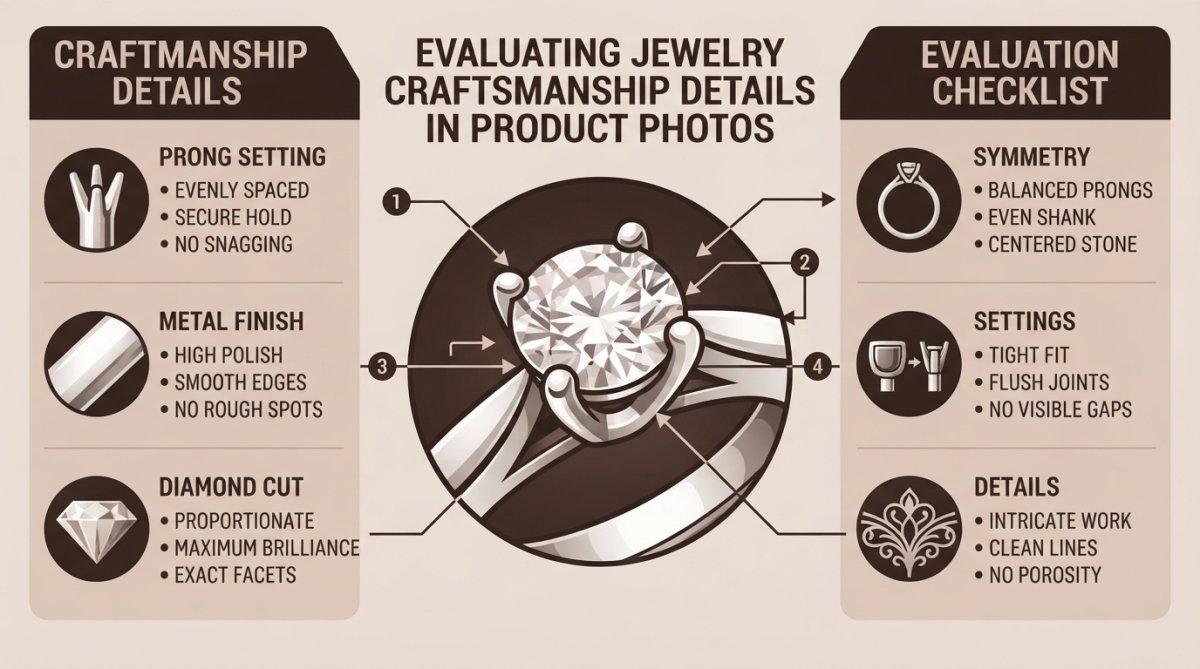
Craftsmanship quality is visible in the details if you know where to look. Request macro-photography of the setting, prongs, and any soldering or joinery work. Quality jewelry shows clean, precise metalwork; poor craftsmanship shows rough edges, uneven prongs, visible solder lines, or inconsistent metal finish.
Examine the prongs holding the gemstone. In a quality piece, prongs are evenly spaced, symmetrical, and smoothly finished, gripping the stone securely without visible gaps. Soldering joints should be clean and invisible or nearly so. Request photos of the back of the piece as well as the front, both should show the same level of finish and attention to detail.
Evaluating Seller Reputation and Reviews
A reputable seller is your best insurance against counterfeit or misrepresented jewelry. Research the seller thoroughly before purchasing. Check customer reviews on the platform where you're buying, but also search for the seller's name plus "reviews" or "complaints" to see if independent review sites mention issues.
Look for specific, detailed reviews rather than generic praise. A review that says "The hallmark matched the certificate, shipping was fast, and the stone sparkles as described" demonstrates that the reviewer actually verified the product. Seller tenure matters too, a seller with five years of history and thousands of transactions has more to lose from fraud than a new seller. Check how long they've been operating and what percentage of their transactions have positive ratings. Anything below 98% positive should raise questions.
Transparency about return policies and warranties is a strong credibility signal. A seller confident in their product will offer a reasonable return window, typically 14 to 30 days, and will provide a written warranty covering craftsmanship and materials.
Importance of Return Policies and Warranties
A transparent return policy is your safety net when buying jewelry online. A minimum 14-day return window gives you time to receive the piece, inspect it in person, and verify that it matches the description. The best return policies cover the full purchase price and include return shipping or a prepaid return label.
A warranty covering craftsmanship and materials is equally important, typically covering defects like loose stones, broken prongs, or failed clasps for one to three years. If a seller offers no warranty, you have no recourse if the piece breaks shortly after arrival. Document everything by taking photos and videos of the jewelry when it arrives, before you wear it.
| Policy Element | What to Look For | Red Flag |
|---|---|---|
| Return window | 14-30 days minimum | No returns offered |
| Return shipping | Prepaid label or full refund | Buyer pays return shipping with no compensation |
| Warranty period | 1-3 years on craftsmanship | No warranty or "as-is" sales only |
Verifying Gemstone Authenticity and Secure Transactions
Natural diamonds show natural characteristics called inclusions, tiny imperfections that are actually proof of authenticity. Lab-created diamonds are chemically identical but lack these inclusions and cost significantly less. Neither is inherently "better," but they should never be confused or misrepresented.
Many rubies and sapphires are heat-treated to improve color or clarity, standard industry practice and acceptable, but it should be disclosed. Ask directly if treatment isn't mentioned.
For secure payment, use credit cards or payment platforms that offer buyer protection. Credit cards provide chargeback protection if the item doesn't match the description. Wire transfers and cryptocurrency offer no recourse if something goes wrong. Verify that the website uses HTTPS encryption (look for the padlock icon in your browser's address bar) and request written confirmation of all details: metal type and purity, gemstone specifications, size, weight, and any certifications.
Creating a Quality Jewelry Checklist
To simplify your evaluation process, use this checklist before purchasing any piece online:
- Request macro-photography of hallmarks and verify they match the claimed metal type
- For gemstones above a certain value, request the GIA or AGS certificate number and verify it
- Examine close-up photos of prongs, settings, and soldering work for clean, precise craftsmanship
- Research the seller's reputation across multiple platforms and check for complaints
- Confirm the return policy covers at least 14 days with reasonable return shipping terms
- Verify the seller offers a written warranty on craftsmanship and materials
- Use a payment method with buyer protection (credit card, PayPal, or similar)
- Confirm the website uses HTTPS encryption (padlock icon visible)
- Request written confirmation of all product specifications before purchase
- Verify any gemstone treatments are disclosed in writing
This checklist takes about ten minutes to work through and eliminates most risk. Sellers worth buying from will provide all this information without hesitation.
Summary: Your Path to Confident Online Jewelry Purchases
Spotting quality jewelry online boils down to three core practices: verifying materials through hallmarks and certifications, assessing craftsmanship through detailed photography, and building confidence in the seller through reputation research and transparent policies. Quality sellers expect these questions and welcome them.
When you're ready to purchase, The Daily Drop by Ed Rivera offers curated jewelry selections with transparent product descriptions, clear return policies, and competitive pricing on quality pieces. Knowing how to spot quality jewelry online ensures you're getting genuine value for your investment.
Frequently Asked Questions
What are the red flags when buying jewelry online?
Watch for sellers who lack transparency about metal composition, gemstone certifications, or craftsmanship details. Red flags include vague product descriptions, no return policy, missing or blurry photos, no hallmarks or karat stamps visible, sellers with poor customer reviews, unverified certifications, and prices that seem too good to be true. Reputable sellers always provide GIA or AGS certification numbers for gemstones and clearly disclose whether jewelry is solid precious metal, gold-filled, vermeil, or plated.
How can I verify a seller's reputation when buying jewelry online?
Check customer reviews on the seller's website and third-party platforms for patterns of buyer satisfaction. Look for detailed feedback about product quality, shipping speed, and customer service responsiveness. Verify the seller offers a clear return policy and warranty. Confirm they display trust signals like secure checkout options, buyer protection guarantees, and transparent contact information. Reputable online jewelry stores often provide jewelry appraisal services or certificates of authenticity. Ask the seller directly about their sourcing practices and willingness to answer technical questions about craftsmanship and materials.
What certifications should I look for when buying gemstones online?
The most trusted gemstone certifications come from GIA (Gemological Institute of America) and AGS (American Gem Society). These organizations grade diamonds and colored gemstones based on clarity, cut, carat weight, and color using standardized criteria. When shopping for jewelry, request the certification number and verify it directly with the certifying lab's website. Be cautious of generic or unverifiable certifications. For precious metals, look for hallmarks indicating karat weight (14K, 18K for gold; 925 for sterling silver). A reputable seller will provide documentation or certificates of authenticity for bespoke jewelry or high-value pieces.
How important are product images when assessing online jewelry quality?
Product images are critical for spotting quality jewelry online because they're your primary way to evaluate craftsmanship, metal finish, and setting integrity before purchase. Look for multiple high-resolution photos from different angles, including macro-photography that shows prong alignment, surface texture, and any imperfections. Poor-quality or limited photos are a warning sign, reputable sellers invest in professional photography. Images should clearly show hallmarks, certifications, and any gemstone details. If a seller refuses to provide detailed close-ups or macro shots, consider it a red flag. Digital authentication tools and seller transparency about sourcing complement what you can visually assess from photos.
Start your next jewelry purchase with confidence. Use this guide to evaluate listings like a pro, ask the right questions, and buy from sellers who stand behind their work. Quality jewelry is out there, you just need to know where to look.
This article was written using GrandRanker